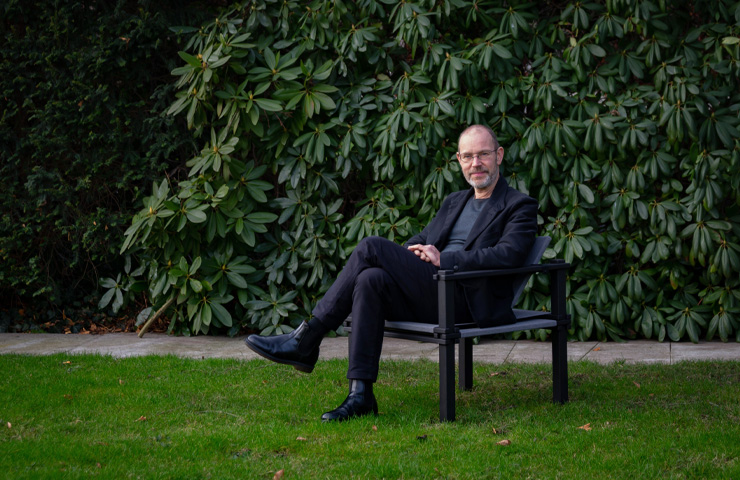


Rheda-Wiedenbrück, 26 August 2026. COR wishes Peter Maly a very happy 90th birthday and celebrates 57 years of creative collaboration. Through his numerous designs, Maly has left an enduring mark on the history of COR and on German interior design as a whole. One question has remained central to his work throughout his career: How can furniture be designed to meet people’s needs and enhance the spaces they live in for years to come? Maly’s answer has never been about following trends or pursuing form for form’s sake. It lies in the interplay of function and aesthetics, clarity of construction and comfort, and a design language with enduring relevance.
Living as a key theme
Maly’s path into design began in the skilled trades. After completing an apprenticeship in carpentry, he studied interior design in Detmold. Upon graduating in 1960 he joined the Schöner Wohnen magazine in Hamburg. For ten years he was a member of the editorial team and the magazine’s lead interior designer before establishing his own design and interior architecture studio in Hamburg in 1970. His years in publishing had a profound influence on his approach to product design. For Maly, a piece of furniture was never an isolated object, but always part of a broader understanding of how people live – and as such, it had to fulfil a clearly defined purpose. As he used to say: “You don’t become a designer just for the sake of it.”
Dialogue between designer and manufacturer
The shared history of Peter Maly and COR began in 1969 with Trinom – his first design for the seating manufacturer in Rheda-Wiedenbrück and only the second furniture design of his career. With its almost Pop Art-inspired aesthetic, colourful plastic shells and comfortable cushions, the seating system captured the spirit of the times and marked the beginning of a long and fruitful partnership. Numerous designs followed, including Zyklus, Cirrus, Tabo, Zelda, Attendo and Circo. Maly played a defining role in shaping COR’s design philosophy, particularly during the 1980s and 1990s.
Design as an attitude
The collaboration with the family-run business was founded not only on mutual respect, but also on a shared sense of responsibility. Maly and Helmut Lübke, COR’s managing director at the time, had similar roots: both began their careers as carpenter’s apprentices. The two of them believed that furniture design should go beyond aesthetics, bringing together concept, craftsmanship, comfort and durability. They also shared the conviction that furniture design and production come with a responsibility to the people who live with it, the companies that make it and the resources used to produce it. The partnership between Lübke and Maly grew into a close creative collaboration and a lasting friendship – and resulted in some genuine furniture classics.
A doll’s armchair makes design history
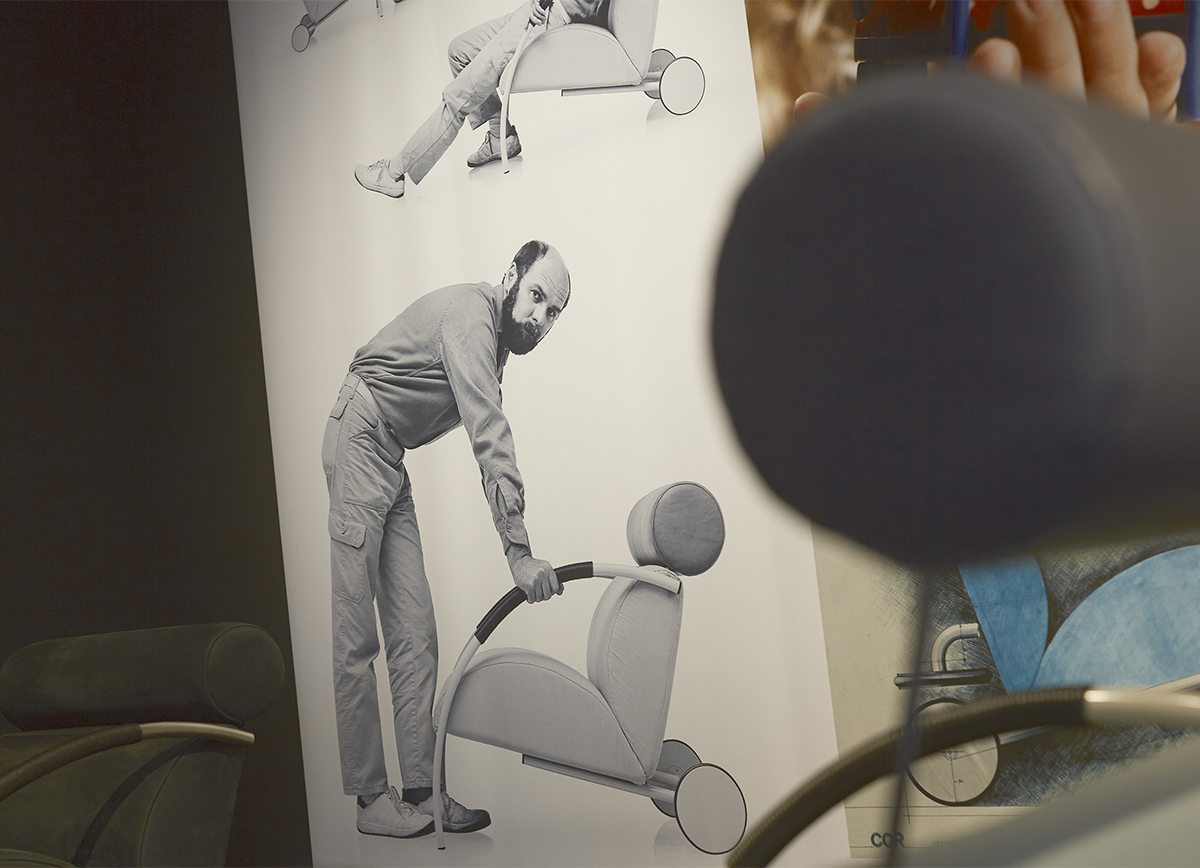
The best-known product of this collaboration is the Zyklus armchair. Its story began in 1983, during preparations for a COR exhibition stand in Milan. While working on an architectural model, Peter Maly furnished it with a miniature armchair from his daughter Laura’s doll’s house. Helmut Lübke, however, saw the potential in this miniature piece for a lightweight armchair that would retain a generous presence even in smaller spaces. The ensuing dialogue between the designer and businessman brought forth a design featuring tubular steel, upholstery and circular forms. The circle is the defining geometric element: it appears as a wheel and adjustable neck roll. Divided in half, it forms the seat and backrest, and as segments of a circle, it shapes the armrests. Zyklus brought Peter Maly to the attention of a wider audience and became an icon of 1980s German design – sculptural in form, yet uncompromisingly comfortable.
Archetypal forms, distinctive character
“Basic geometric shapes – the circle, the square and the flat rectangle – never go out of fashion,” Peter Maly once said of his design philosophy. Drawing on these elemental forms, he created furniture with a distinctive character and a strong spatial presence. His holistic approach extended far beyond the individual product: trade fair stands, showrooms, exhibitions and photographic installations were all integral to his work. With his unmistakable design language and international reputation, Maly ranks among the most influential designers of his generation. His clients have included Thonet, Ligne Roset, Behr International, interlübke, Conde House, Conmoto, Sauter, Carpet Concept and Tecta. His work has also been exhibited at institutions including the Museum für Kunst und Gewerbe Hamburg, the Kunstgewerbemuseum Berlin and the Red Dot Design Museum in Essen. Throughout his career, Peter Maly has demonstrated that longevity in design does not come from neutrality. It comes from clarity, consistency and the courage to pursue a distinctive idea. His work is a reminder of what good design can achieve: it fulfils a purpose, provides comfort, shapes spaces – and stands the test of time.